Building AI agents for complex operations
Why 62% of companies experiment with AI agents, but only 23% manage to scale. And what separates real production from eternal pilots.
The promise of AI agents is to transform business operations: intelligent systems that don’t just execute tasks, but interpret context, make decisions, and adapt to conditions that change in real time.
The reality, however, is harsher than press releases suggest. According to McKinsey, 62% of organizations already experiment with AI agents, but only 23% managed to scale these initiatives beyond the pilot. Gartner projects that over 40% of agentic AI projects will be cancelled by 2027.
The problem isn’t the technology. It’s how it’s implemented. Companies that scale agents in real production share an architecture and a method that sets them apart from the majority.
62%
of companies experiment with AI agents
McKinsey, 2025
40%
of agentic AI projects will be cancelled by 2027
Gartner, 2025
3-4h
per day spent on repetitive manual tasks
ProcessMaker, 2024
The difference between automating and operating with intelligence
Traditional automation (RPA) and AI agents solve different problems. RPA is deterministic: it follows a fixed sequence of rules, executes the same operation the same way, every time. It works well for structured, repetitive tasks. But when the process changes, when data arrives in unexpected formats, or when exceptions appear, RPA fails silently or stops.
AI agents are goal-oriented, not rule-oriented. They interpret context, decompose complex tasks into steps, and adapt when conditions change. They operate with unstructured data (emails, documents, conversations) and make decisions within governance-defined boundaries.
The RAND Corporation documents that 80% of AI projects fail, double the rate of conventional technology projects. But the most relevant finding comes from McKinsey: the strongest predictor of AI success isn’t the technology chosen. It’s whether the organization fundamentally redesigned its workflows when implementing AI.
This is why the OORT AI Assessment exists before any implementation. It maps processes, identifies where agents generate the most value, and redesigns operational flows before building any automation.
Why agent pilots stall before scaling
MIT identified, in a study with over 800 companies, that 95% of generative AI pilots don’t generate revenue acceleration. S&P Global Market Intelligence reports that 42% of companies abandoned most of their AI initiatives in 2025, more than double the 17% recorded the previous year.
Gartner warns that only about 130 of the thousands of vendors presenting themselves as agentic AI providers are "real." The rest practice "agent washing": renaming chatbots, RPA scripts, or simple workflows as "AI agents." The result is a wave of implementations that don’t deliver what they promise.
The three most common causes of cancellation are: costs escalating without measurable value, absence of governance frameworks, and misaligned expectations between what was purchased and what was delivered. Each of these causes is avoidable with method. We wrote about this pattern in detail: why 95% of AI pilots fail before scaling.
“To scale AI agents, the question isn’t whether the technology works. It’s whether the operation was redesigned to receive it.”
The architecture of agents that operate in production
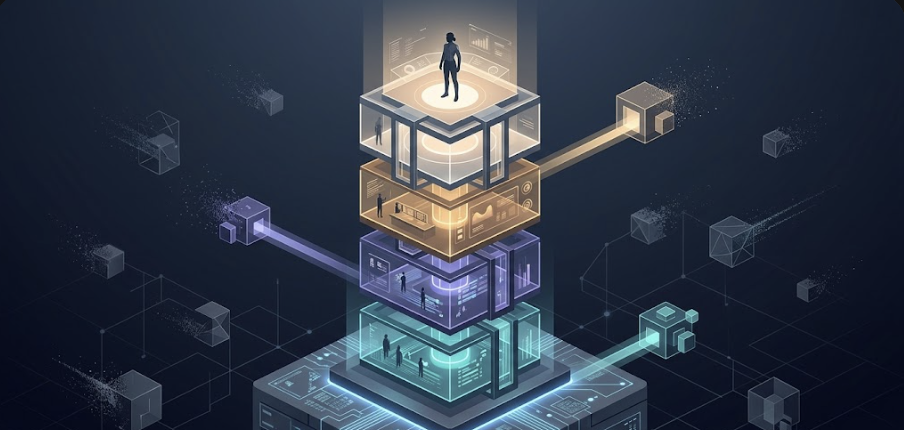
AI agents in production aren’t language models with tool access. They’re systems with five interdependent layers, each solving a different problem. Skipping any of them is the recipe for the eternal pilot.
OORT Flows Architecture
Human-in-the-loop
Approval, exceptions, override
Governance
Traceability, auditing, circuit breakers
Specialized agents
Defined scope, specific competencies
Orchestration
Routing, sequencing, parallelism
Structured data
AI-First Data: ingestion, normalization, serving
The AI-First data layer is the foundation. Without structured, accessible, and governed data, agents produce imprecise results or simply don’t work at scale. It’s the equivalent of building a skyscraper without a foundation.
The orchestration layer coordinates multiple specialized agents. There’s no single agent that does everything. What exists is a multi-agent architecture where each agent has a defined scope and a central orchestrator distributes tasks, manages dependencies, and consolidates results. Organizations with this architecture achieve 45% faster resolution and 60% more precise results.
The OORT Flows agents operate with native governance: every action is logged, auditable, and reversible. Circuit breakers prevent infinite loops. Confidence thresholds automatically trigger human review when the agent operates below the defined threshold.
Traditional automation (RPA)
Fixed rules and structured processes
Silent failure on exceptions
No adaptation to changes
Structured data only
Linear scaling (more bots = more cost)
AI Agents (OORT Flows)
Goal-oriented, adaptive
Detect and handle exceptions
Adapt to new conditions
Operate with unstructured data
Exponential scaling (platform effect)
The role of human-in-the-loop
Fully autonomous agents are the long-term goal, but not the starting point. Deloitte identifies that only 21% of companies have mature governance models for agentic AI. Without governance, full autonomy is risk.
The model that works in production operates at three levels. Synchronous approval for high-risk operations: financial transactions, data deletion, decisions affecting people. The agent prepares, the human authorizes. Asynchronous auditing for routine operations: the agent executes, decisions are logged and reviewed periodically. Confidence thresholds as an automatic mechanism: responses below 85-95% confidence trigger human review without manual configuration.
Circuit breakers complement the system: if an agent exceeds an iteration limit (e.g., 10 attempts without resolution), the system forces a transition to exception handling. This prevents infinite loops and uncontrolled costs.
At OORT Culture, we prepare teams to operate in this hybrid model. The goal isn’t to replace people with agents. It’s to free people for work that requires judgment, creativity, and relationships, while agents handle what’s repetitive, predictable, and high-volume.
45%
faster resolution with multi-agents
OnAbout.ai, 2025
60%
more precision vs single agent
OnAbout.ai, 2025
30-70%
operational cost reduction with agents
WeAreTenet, 2025
14%
of companies have agents in production
Deloitte, 2026
The agent operation cycle
Agents in production operate in a continuous cycle. It’s not a project with a beginning and end. Each cycle generates data that feeds the next: agents become more precise, processes more efficient, cost per operation lower.
Operational Cycle
Map
Redesign
Build
Monitor
Optimize
Agents
Map
Redesign
Build
Monitor
Optimize
Real production, not demonstration
Only 14% of companies have deployable AI agents in production today. The distance between experimenting and operating is the same as between having a prototype and having a business.
Companies that cross this barrier share three characteristics: structured data as foundation, processes redesigned before automation, and native governance, not added afterwards. Each of these characteristics is an architecture decision, not a technology one.
AI agents aren’t the next tech hype. They’re the operational infrastructure of the next decade. But only for those who build them with method, governance, and the discipline to redesign before automating.
Read also
Ready to move beyond the pilot?
The AI Assessment maps your processes, identifies where agents generate the most value, and delivers a roadmap with projected ROI. Diagnosis in days, not months.
Schedule an AssessmentSources
- McKinsey — State of AI 2025
- Gartner — Over 40% of Agentic AI Projects Will Be Canceled by 2027
- Gartner — 40% of Enterprise Apps with AI Agents by 2026
- MIT — The GenAI Divide Report (2025)
- Deloitte — Tech Trends 2026: Agentic AI Strategy
- RAND Corporation — AI Project Failure Rates
- S&P Global — AI Initiative Abandonment (2025)
- ProcessMaker — Repetitive Tasks at Work Statistics
- OnAbout.ai — Multi-Agent Orchestration Benchmarks
Frequently asked questions
RPA operates with fixed rules and structured processes: it executes the same sequence of steps, the same way, every time. AI agents are goal-oriented: they interpret context, decompose complex tasks into steps, adapt when conditions change, and operate with unstructured data. RPA is the hand of automation. AI agents are the brain. The most advanced companies combine both: RPA for high-volume execution, AI agents for decision-making and adaptation.
According to Gartner, over 40% of agentic AI projects will be cancelled by 2027 due to costs escalating without clear value, absence of governance, or "agent washing" (vendors renaming chatbots as agents). MIT identified that 95% of generative AI pilots don’t generate revenue acceleration. The strongest predictor of success is redesigning workflows before applying AI, not just adding technology on broken processes.
A multi-agent architecture uses multiple specialized agents that collaborate to solve complex problems. Each agent has a defined scope and specific competencies. A central orchestrator coordinates execution, routing tasks to the most suitable agent. Organizations with multi-agent architectures achieve 45% faster resolution and 60% more precise results than single-agent systems.
High-risk operations (financial transactions, data deletion, decisions about people) require synchronous human approval. Routine operations can operate with asynchronous auditing, where the agent executes and decisions are reviewed afterwards. Best practice is to use confidence thresholds: responses below 85-95% confidence automatically trigger human review. Circuit breakers prevent infinite loops.
ROI should be measured by concrete operational indicators: reduced resolution time, eliminated operational cost, volume processed without human intervention, and precision rate in production. Companies that implement agents strategically report 30% to 70% reductions in operational costs for specific workflows. The OORT AI Assessment projects ROI before implementation.
Real production requires five layers: structured data as foundation (AI-First Data), orchestration to coordinate multiple agents, specialized agents with defined scope, governance with traceability and circuit breakers, and human-in-the-loop for exceptions. Only 14% of companies have deployable agents in production today (Deloitte). The gap between experimentation and real operation is the main challenge.