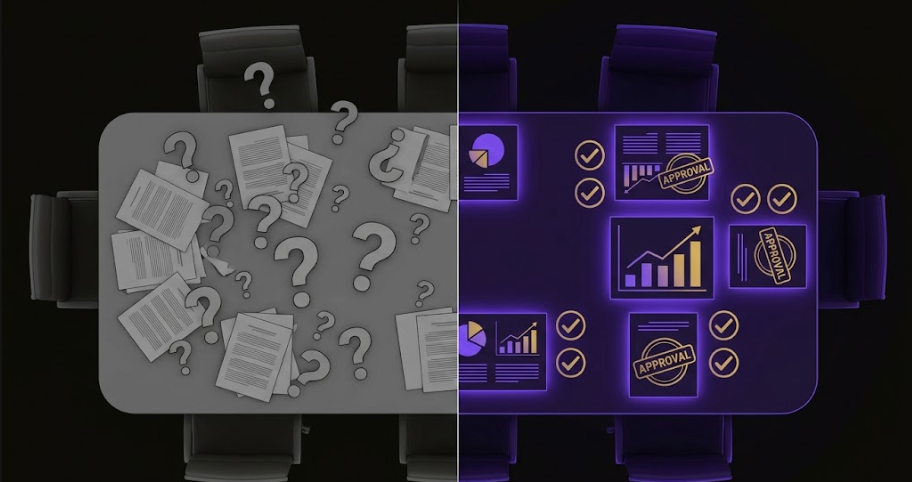
如何构建AI的商业论证
The 4-phase playbook to present AI to the board and get approval. It’s not about technology — it’s about P&L, payback, and governance.
You know AI can transform operations. Your technical team is ready. But the board wants numbers, not enthusiasm. And most AI business cases fail before reaching approval — because they talk about models and tokens when they should talk about cost, savings, and payback.
McKinsey identifies that the strongest predictor of success in AI projects isn’t the chosen technology — it’s executive sponsorship. And executive sponsorship only happens when the business case is articulated in language the board understands: how much does the problem cost, how much do we save, when does it pay back, and how do we control risk.
This playbook shows how to build that business case in 4 weeks. It’s not a theoretical framework — it’s the process we use with our clients before any implementation.
Who this playbook is for
CEO / COO
Who needs to present the proposal to the board
CFO
Who needs to validate the numbers before approving
VP / Director of Operations
Who will execute and needs leadership buy-in
The 4-phase playbook
Before talking about AI, talk about cost. Survey how much the company loses with the current process: manual hours, error rate, rework, opportunities lost to slowness.
Questions that need answers
How much does this process cost today? (people × hours × cost/hour)
What is the error rate and how much does each error cost?
How many hours per week are spent on tasks that don’t require human judgment?
What happens if we change nothing over the next 12 months?
Output of this phase
Annual cost of the status quo — the number that justifies any investment.
With the current cost mapped, project savings with intelligent automation. Use industry benchmarks as a baseline and adjust for the company’s reality.
Questions that need answers
What % of the process can be automated with AI? (benchmarks: 25-35% depending on industry)
What is the expected reduction in resolution time?
What is the impact on error rate?
Are there indirect gains? (talent retention, decision speed, scalability)
Output of this phase
Projected savings at 12, 24, and 36 months — the upside of the investment.
The board wants to know: how much does it cost and when does it pay back. Include all costs: platform, implementation, team training, pilot opportunity cost.
Questions that need answers
What is the total investment for the pilot? (platform + implementation + training)
In how many months does the investment pay back?
What is the pessimistic vs optimistic scenario?
What happens if we cancel after the pilot?
Output of this phase
Projected payback and scenario analysis — the security the CFO needs.
Boards reject projects without controls. Define how success will be measured, who is responsible, and what the go/no-go criteria are for scaling.
Questions that need answers
Which KPIs will we measure in the first 90 days?
Who is the executive sponsor and who is the operational owner?
What are the criteria to decide between scaling, adjusting, or discontinuing?
How do we ensure compliance with LGPD and internal policies?
Output of this phase
Governance framework and tracking dashboard — the control the board demands.
“Boards don’t reject AI. They reject proposals that talk about technology without talking about returns.”
Checklist: what the board needs to see
Before scheduling the presentation, verify that your business case covers these 10 points. If any are missing, the board will ask — better to already have the answer.
Board readiness checklist
Current process cost (quantified in currency)
Cost of doing nothing for 12 months
Projected savings (conservative scenario)
Payback in months (not years)
Total investment for the pilot
Pilot timeline (60-90 days)
Measurable KPIs for the first 90 days
Go/no-go criteria for scaling
Executive sponsor defined
Risk mitigation plan
The shortcut: Assessment as business case
The 4 phases of this playbook can take 4 weeks if done internally. Or they can be compressed with a structured diagnosis that already delivers the business case as output.
The OORT AI Assessment maps processes, surveys costs, projects savings, and delivers the roadmap with projected ROI. The result is exactly what the board needs to see: numbers, timeline, and governance. Not technology.
If your challenge isn’t convincing yourself that AI makes sense — it’s convincing the board — the Assessment is the fastest path from idea to approval.
Proposal the board rejects
“We need AI so we don’t fall behind”
Focuses on technology (GPT, LLM, agents)
Vague ROI: “will improve efficiency”
No clear return timeline
No go/no-go criteria
Proposal the board approves
“This process costs $2.4M/year — we can reduce by 35%”
Focuses on cost, savings, and payback
Projected ROI: $840K/year, 5-month payback
90-day pilot with clear metrics
Criteria to scale, adjust, or stop
AI isn’t an IT project. It’s a business decision.
Companies that treat AI as an IT project fail. Those that treat it as a business transformation thrive. The difference starts with the business case: a document that speaks the board’s language, quantifies the problem, projects the return, and defines how risk will be controlled.
If your AI project needs approval, don’t start with technology. Start with the numbers. The board doesn’t reject AI — it rejects proposals without financial foundation.
延伸阅读
Need the business case ready?
The AI Assessment delivers the business case as output: prioritized processes, projected ROI per workflow, and implementation roadmap. What the board needs to see, in days.
预约评估常见问题
It’s the document that justifies the investment in artificial intelligence for company leadership. It includes: which problem will be solved, how much it costs not to solve it, projected savings, required investment, timeline to return, and how success will be measured. Without a structured business case, AI projects compete for budget without criteria.
The ideal executive sponsor is someone from the business side (COO, VP of Operations, CFO), not IT. According to McKinsey, the strongest predictor of AI success is genuine executive sponsorship. The CTO or CIO can be the technical executor, but the business case needs to be articulated in P&L language, not infrastructure.
Map the target process and gather three numbers: current operation cost (people, time, errors), projected savings with automation (based on industry benchmarks), and required investment (platform, implementation, training). The AI Assessment does this calculation before any implementation, with real operational data.
With structured diagnosis, 2-4 weeks. Without diagnosis, it can take months of back and forth with IT, vendors, and consultancies. The OORT AI Assessment delivers the business case as output: prioritized processes, projected ROI, and implementation roadmap.
Three things: (1) the cost of doing nothing (quantify current inefficiency), (2) the expected return with a clear time horizon (payback in months, not years), and (3) the risk and how it will be mitigated (controlled pilot, go/no-go metrics, governance). Boards reject proposals that talk about technology without numbers.
Always with a controlled pilot on a high-impact process. Gartner recommends choosing the process with the highest combination of volume, repetition, and cost. Validate in 90 days with clear metrics. Only scale with evidence. Companies that start with “complete transformation” have an 80% chance of failure (RAND Corporation).