L’IA dans l’industrie : comment les usines dépassent le stade du pilote
80 % des entreprises industrielles utiliseront l’IA en production d’ici 2026. Mais le goulet d’étranglement n’est pas l’algorithme — ce sont les données. Les 4 cas d’usage au meilleur ROI et le chemin pour sortir du pilote éternel.
In 2026, artificial intelligence in manufacturing has moved from innovation project to operational infrastructure. Deloitte projects that over 80% of industrial companies will have generative AI in production environments by year-end. The Brazilian government announced R$ 23 billion in investments in the Brazilian Artificial Intelligence Plan.
But the reality on the factory floor is different from the press release. Most industrial AI projects die in the pilot. The problem isn’t the algorithm — it’s the disconnect between the data that exists in the factory and what AI needs to operate. Sensors generating terabytes without standardization, SCADA that doesn’t talk to ERP, MES isolated from planning. EY identifies that the biggest bottleneck of industrial digital transformation isn’t in the models, but in the data.
This article maps the 4 AI use cases with the highest proven ROI in manufacturing, explains why data is the real bottleneck, and shows the path out of the pilot. If you’ve read our practical guide to AI in operations, this article goes deeper into the sector with the largest investments.
80%
des entreprises will use generative AI in production by 2026
Deloitte, 2026
R$ 23 bn
d’investissement prévus dans le Plan IA brésilien
PBIA, 2024
30-60%
de réduction des arrêts avec la maintenance prédictive
McKinsey, 2025
Why manufacturing is different
Applying AI on the factory floor isn’t the same as applying AI in the back-office. The differences are structural and determine why approaches that work in sales or marketing fail in industrial production.
Le chiffre is different. Instead of spreadsheets and CRMs, manufacturing generates data from IoT sensors, SCADA systems, programmable logic controllers (PLCs), and MES (Manufacturing Execution Systems). These are high-frequency data, often unstructured, with proprietary protocols that don’t communicate with each other. A vibration sensor generates 10,000 readings per second. A SCADA system monitors 200 variables per machine. Volume isn’t the problem — lack of standardization is.
Latency is critical. In an e-commerce, an AI agent can take 5 seconds to respond and no one notices. On a production line, a 5-second delay in detecting an anomaly can mean an entire batch discarded. Industrial AI needs to operate in real-time or near-real-time, requiring edge computing architectures that most pilots don’t consider.
OT and IT are separate worlds. Operational technology (OT) on the factory floor has historically operated in isolation from corporate information technology (IT). Integrating these two worlds is a prerequisite for AI to work — and it’s where most projects stall.
The 4 use cases with the highest proven ROI
Not every industrial process benefits equally from AI. The four use cases below are those that consistently deliver measurable ROI in real operations — not in controlled pilots.
Predictive maintenance
Sensors monitor vibration, temperature, and energy consumption in real-time. AI agents detect degradation patterns weeks before failure, scheduling maintenance at the optimal moment — not too early (waste) or too late (downtime).
30-60%
de temps d’arrêt non planifié en moins
McKinsey
Visual quality control
Cameras with computer vision inspect 100% of production in real-time, detecting defects invisible to the human eye. Reduces escape rate (defects reaching the customer) and eliminates manual sampling.
90%+
de précision dans la détection des défauts
IBM Manufacturing
Dynamic production planning
Replaces rigid MRP with continuous scenario-based planning. Agents recalculate sequencing, machine allocation, and prioritization in real-time when orders change, raw materials are delayed, or machines become unavailable.
15-25%
d’amélioration du TRS
Deloitte
Supply chain optimization
Demand forecasting with 20-30% higher accuracy than traditional statistical methods. Combines internal data (sales, inventory, production) with external signals (weather, events, trends) to automatically adjust purchasing and inventory.
20-30%
de précision supplémentaire dans la prévision de demande
EY
“Manufacturing in 2026 doesn’t fail from lack of AI. It fails from lack of structured data for AI to operate on.”
The bottleneck isn’t the algorithm — it’s the data
CIMM (Metal Mechanics Information Center) and EY converge on the same diagnosis: the biggest obstacle to industrial AI is fragmented, ungoverned data. It’s not a lack of data — factories generate terabytes per day. It’s a lack of structure.
The most common problems: sensors with different protocols that don’t communicate, SCADA isolated from MES, MES that doesn’t talk to ERP, historical data in proprietary formats without versioning. Each machine generates data in its own format, on its own timing, using its own protocol. Without a unification layer, AI operates with a fraction of available information.
The AI-First data layer solves this bottleneck. It extracts data from multiple sources (sensors, PLCs, SCADA, MES, ERP), standardizes it into a format consumable by AI agents, and ensures governance and traceability. Without this foundation, any industrial AI project is built on sand.
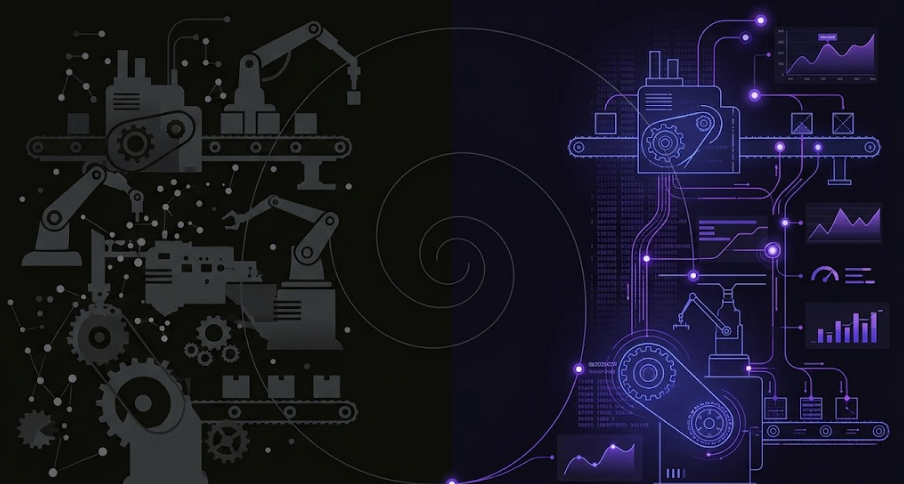
Traditional factory
Calendar-based or breakdown maintenance
Quality inspection by manual sampling
Rigid MRP planning, weekly/monthly
Data in silos (SCADA, MES, ERP separate)
Decisions based on outdated reports
Factory with operational AI
Predictive maintenance based on real data
100% automated inspection with computer vision
Dynamic real-time planning
Unified data with AI-First layer
Real-time decisions by specialized agents
How to start: from current factory to intelligent operations
The path follows the same framework we detailed in our practical guide to AI in operations, adapted for the industrial reality:
Phase 1: Industrial diagnosis. The AI Assessment maps factory floor processes, identifies the 3-5 use cases with the highest return, and evaluates data maturity in each area. Result: roadmap with projected ROI, impact-based prioritization, and data plan.
Phase 2: Data foundation. AI-First Data unifies data from sensors, SCADA, MES, and ERP into a standardized layer. Without this step, AI agents operate with incomplete information and produce imprecise results.
Phase 3: Agents in production. OORT Flows implements specialized agents for each prioritized use case. Each agent operates with defined scope, native governance, and continuous monitoring. The first agent goes into production within 4 to 8 weeks.
45%
d’arrêts non planifiés en moins with predictive maintenance
McKinsey, 2025
25%
d’amélioration du TRS with dynamic planning
Deloitte, 2026
35%
de réduction du stock dormant with demand forecasting
EY, 2025
4-8 wks
pour le premier agent en production with Assessment
OORT Labs
The smart factory isn’t the one with more AI — it’s the one with better data
The difference between a factory that experiments with AI and one that operates with AI isn’t the investment in models or tools. It’s the discipline of structuring data before training agents, mapping processes before automating, and measuring results in real production — not in controlled demonstrations.
Agentic AI is the most transformative technology manufacturing has seen since programmable automation. But real transformation requires real foundation. And in manufacturing, that foundation is structured, accessible, and governed data.
Lire aussi
Vous souhaitez identifier où l’IA génère le plus de ROI dans vos opérations industrielles ?
The AI Assessment diagnoses factory floor processes, evaluates data maturity, and delivers a roadmap with projected ROI per use case.
Planifier un Assessment IndustrielSources
- Deloitte — Perspectivas para a Indústria de Manufatura 2026
- EY — Manufatura Avançada na Era da IA
- CIMM — Manufatura 2026: Dados, IA e Pessoas
- McKinsey — State of AI 2025
- IBM — AI in Manufacturing
- Plano Brasileiro de Inteligência Artificial (PBIA)
- Gartner — 80% of Enterprises Will Use GenAI APIs by 2026
- RAND Corporation — AI Project Failure Rates
Questions fréquentes
The four with the highest proven return are: predictive maintenance (30-60% reduction in unplanned downtime), visual quality control (automated defect detection), dynamic production planning (replacing rigid MRP with real-time adjustments), and supply chain optimization (demand forecasting + inventory management). ROI depends on production volume and data maturity.
Probably not — and that’s normal. The biggest bottleneck in industrial AI is unstandardized data across sensors, SCADA, MES, and ERP. IBM estimates that 73% of enterprise data is never used. The first step is to unify and structure this data with an AI-First layer, not to buy AI tools.
No. AI integrates with existing systems via APIs and connectors. MES continues controlling the factory floor, ERP continues managing finances. The AI layer operates on this data to generate predictions, detect anomalies, and optimize decisions — without replacing current infrastructure.
With prior diagnosis and minimally structured data, the first agents go into production within 4 to 8 weeks. Projects without diagnosis typically take 6 to 12 months and frequently get stuck in the pilot. The critical phase isn’t implementation — it’s process mapping and data organization.
Yes. Most factories operate with systems that are 10-20 years old. The correct approach is to create an intermediary data layer that extracts, standardizes, and unifies information from multiple sources (sensors, PLCs, SCADA, MES, ERP) without requiring migration. It’s faster and less risky than replacing systems.
The metrics that matter are operational: OEE (Overall Equipment Effectiveness), reduction in unplanned downtime, detected vs. escaped defect rate, demand forecast accuracy, and production cycle time. Avoid vanity metrics like "number of trained models." Measure impact on the P&L.